Apologies for the silence on here over the summer. One of the things that kept me busy was a talk I gave recently for The Erotic Review at the Kensington Roof Gardens, on top of what used to be the Derry and Toms department store. The talk was about a police investigation in the summer of 1966 into a basement flat at 57 Cornwall Gardens, about half a mile to the south, where obscene films were being shown and obscene photographs were being taken. One of the people arrested was the enigmatic photographer Ivor Cook. I have adapted the talk into this post, and focused it on what the case tells us about how pornography was made at the time and about Cook himself.
The raid
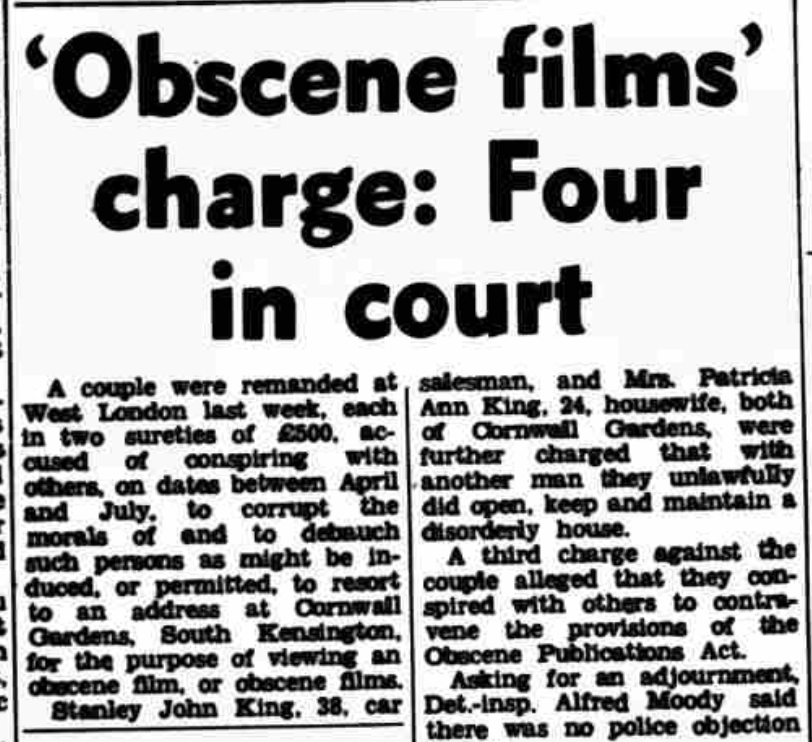
Acting on a tip, a reporter from The People named William Gardener rang a number and got through to a Mrs King. He told her he was looking for some “entertainment”. She suggested “blueys”, which was slang for pornographic films, and said that she and plenty of other girls would be there. Gardener went along with a staff photographer and paid £5 to get in. He later told the court that he saw films of couples having intercourse, and that women there offered sexual services for a further fee.
Gardener reported this to the police and returned a few days later with an officer. Mr and Mrs King spotted the casually dressed policeman outside, took him for a gatecrasher, and complained about him to another passing policeman. That officer asked what sort of party it was. Mr King invited him in to see for himself, and the flat was raided.
Four men and one woman were arrested. One of the men, a German carrying a wooden box of photographic equipment, was asked what it was for. “We are kinky, man,” he said. “This is a kinky household.” His boss was found next to a set of obscene photographs taken in the flat. When it was put to him that he had obviously taken them, he was offended. “I am a first-class photographer,” he said. “The quality of these speak for themselves. Of course I did not take them, but I like that sort of thing. We are all a bit kinky.”
His name was Ivor Cook. He ran a photographic studio in East Molesey and advertised his services in the British Journal of Photography. By 1966 he had been making Soho postcards and 8mm films for the under-the-counter trade for several years.
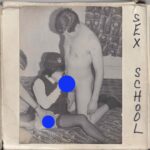
The Cornwall Gardens case suggests something about how pornography was made in this period. The flat was being used to show blue movies to paying guests, but the arrests point to more than screenings. Cook was found next to obscene photographs that had been taken in the flat, and his assistant was carrying a box of photographic equipment. This suggests the parties were also being used to produce new material, both photographs and possibly films. A party of this kind gave a photographer somewhere to shoot and people willing to be photographed. The guests who paid £5 to watch were also the kind of people who would buy the results.
The trial
The prosecution itself again highlights the ineffectiveness of the law. The Obscene Publications Act 1959 did not neatly cover charging strangers £5 to watch films in a basement, so the group was charged with conspiring to corrupt public morals, a common law offence that had only recently been revived.
Cook was already paying the Obscene Publications Squad to be left alone, through a middleman named Frankie Hulpert, and he knew the head of the squad, Detective Chief Inspector Bill Moody. That arrangement protected him from the police but could do nothing about a newspaper exposé. Before the trial, Cook gave Moody £200 in cash to look after his interests at the Old Bailey. Cook was fined £200 and avoided prison.
Moody was jailed for twelve years in 1977, and Cook was among those interviewed by the investigation that convicted him. Cook paid off his fine in instalments and carried on working. By the end of the 1970s he was a senior photographer for the Swedish company Private. He died in 1985.